
Many business plans look like crime scenes for Excel sheets.
What do I mean by that? Endless rows of numbers, half-explained assumptions, and the occasional graph that nobody understands. Additionally, it may be a set of slides, to make it look nice.
Then, after weeks of work, the whole thing gets parked in a folder called Final_V3_ReallyFinal_ThisOne.pptx and is never opened again.
Did you see such plans?
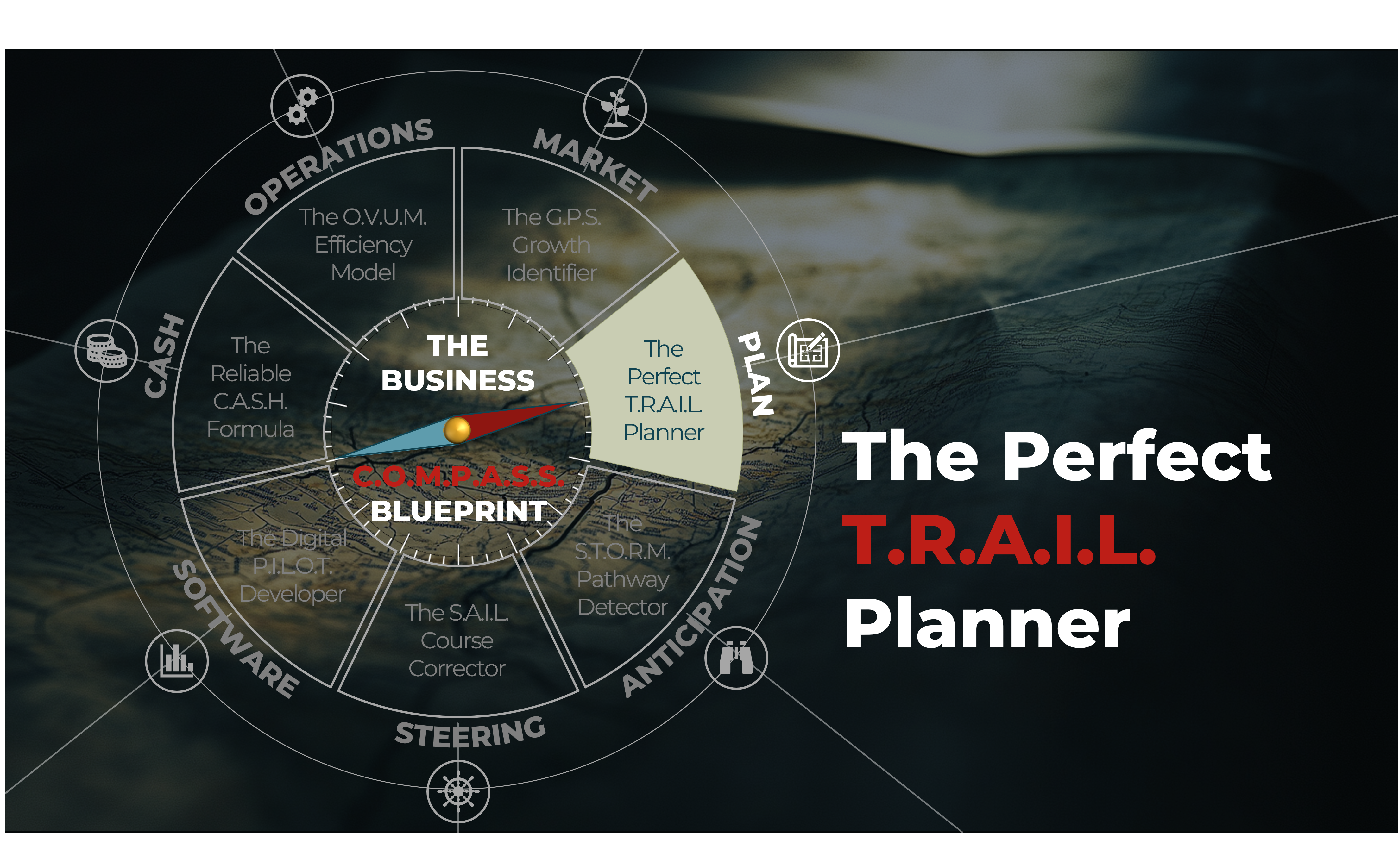
The good news: planning doesn’t have to be that painful. The TRAIL System gives you a structured path to follow, so your plan actually helps you run the business instead of gathering digital dust in a corner of your document management system.
So what are the steps for business planning?
1. Template – Start with a map (and a checklist)
A template is your plan’s skeleton, showing where the goals, numbers, and ideas should go. And it is also your checklist: a way to make sure you’ve ticked off all the critical parts and aren’t leaving holes in the plan.
Without it, planning quickly turns into a digital equivalent of a pile of sticky notes and random spreadsheets. With it, you’ve got both a roadmap and a checklist that keeps your plan focused, structured, and complete.
2. Responsibilities – Someone’s got to own it
Plans love to fall into the “everyone’s job” category. Translation: nobody does it.
Assigning responsibilities means each part of the plan has a clear owner. It avoids the classic “Oh, I thought you were handling that” moment and keeps the whole thing moving forward.
3. Assemble – Put the puzzle together
This is the stage where the plan becomes real. Big-picture goals meet ground-level insights, and the result is something that’s not just wishful thinking from the top or a shopping list from the team.
Instead, you get a balanced plan that makes sense in practice and has buy-in from the people who need to make it happen.
4. Inform – Don’t keep it a secret
A plan hidden in a drawer is about as useful as a treadmill nobody uses. The people who need to act on it should actually know what it says. Simple, clear communication—whether it’s quick updates, shared dashboards, or short meetings—keeps everyone aligned and prevents those dreaded “Wait, we’re doing what?!” surprises.
5. Lead – Turn words into action
Here’s where the rubber meets the road. Execution is rarely smooth. Things change, deadlines shift, reality messes with your best ideas.
Strong leadership means steering through the bumps, fixing problems early, and making sure the team doesn’t wander off chasing shiny distractions. It’s less about heroic speeches, more about keeping the wheels turning.
Wrapping Up
The TRAIL System is not rocket science. It’s five simple steps: Template, Responsibilities, Assemble, Inform, and Lead. Follow the path, and instead of another forgotten PDF, you’ll have a plan that actually guides what you do day to day.